Free Consultation at 1800 553 788
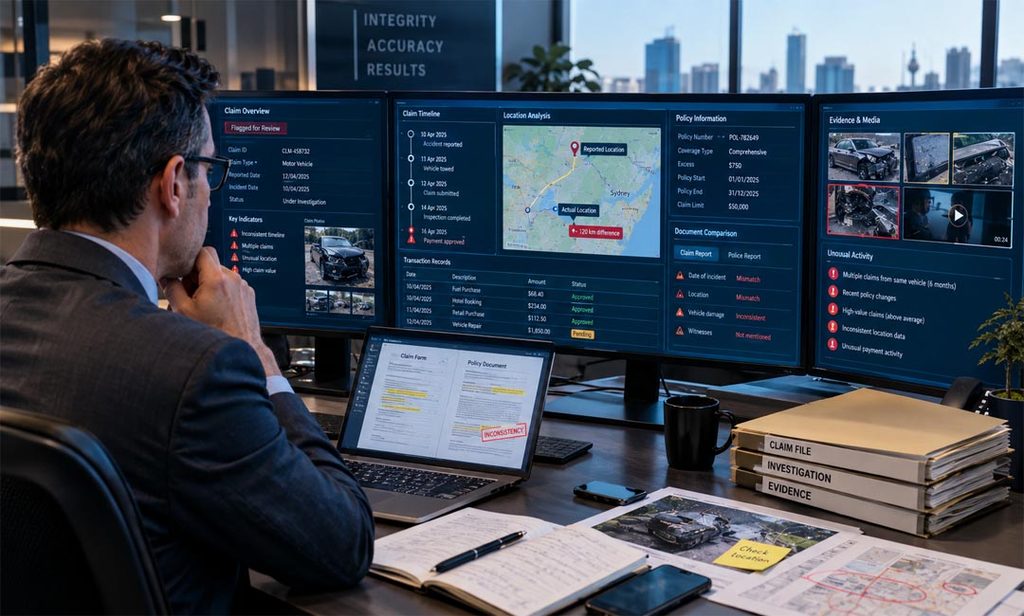
An insurance fraud investigator investigates suspicious insurance claims to determine the facts, confirm information, and determine evidence that can be used to substantiate or refute a claim. They may be required to review documents, check records, interview relevant individuals, conduct surveillance, verify statements and prepare detailed investigation reports.
Motor vehicle, property, workers compensation, liability, income protection and personal injury insurance are just some of the types of insurance that can be affected by insurance fraud. Suspicious claims do not necessarily constitute fraud. If there is conflicting information, evidence doesn’t fit the story, or other red flags are present, though, an insurance fraud investigation can assist in determining what can be substantiated independently.
Investigations in Australia should be carried out carefully and in a legal manner. An insurance fraud investigator Australia can be employed by an insurance company, by a specialist investigation company or as an independent investigator hired to collect objective evidence.
Who is an Insurance Fraud Investigator?
An insurance fraud investigator is a professional who investigates potentially false, misleading, exaggerated, or otherwise suspicious insurance claims.
The investigator’s primary role is fact gathering. They review information and compare evidence to the statements and circumstances related to a claim. This may involve documents, witness statements, photographs, video, publicly available information, timelines, records which can lawfully be accessed and direct observation depending on the matter.
Common duties might include:
- Reviewing claim information and supporting documents
- Identifying inconsistencies or gaps requiring further examination
- Conducting background research using lawful sources
- Interviewing claimants, witnesses, or other relevant people where appropriate
- Conducting surveillance when it is lawful, necessary, and proportionate
- Verifying reported activities, circumstances, and timelines
- Documenting observations accurately
- Preserving relevant evidence
- Preparing a detailed investigation report for the client
An investigator is not just going to conclude that someone is a fraud. They are supposed to collect and record evidence for the insurance company or other party authorized to make the decision.
Insurance Fraud Investigator vs Insurance Claims Assessor
The insurance fraud Assessor is also known as the insurance claims adjuster. Another name for the insurance fraud investigator is insurance claims adjuster.
An insurance claims investigator is a person who mainly evaluates a claim according to the conditions of an insurance policy. This could include checking coverage, loss details, repair costs, medical or other supporting documents, and policy conditions.
A different focus is that of an insurance fraud investigator. They explore the facts and issues of a claim in-depth. Their work can be called upon if there is any information that is not sufficient and would need to be verified.
The two positions may share some of the information that they review, but they have different responsibilities. The assessor reviews the claim, and the investigator focuses on the facts and evidence relevant to the claim.
Common Types of Insurance Fraud
The most frequent kinds of insurance fraud.
There are various ways in which insurance fraud can manifest itself, depending on the type of insurance policy and claim.
False Insurance Claims
A false insurance claim can be a report of an event, loss, injury, theft or damage that was not actually happening as reported. An investigation could be conducted to determine if the reported events are substantiated by the evidence.
Exaggerated Claims
Some suspicious claims are for a real incident but the loss, damage, injury or financial loss is exaggerated. Investigators can compare statements to documentation, observations, timelines and other evidence available.
Staged Incidents
A staged incident is where the allegations of an event are intentionally created or misrepresented in order to meet the requirements of an insurance claim. These issues can be complex and warrant detailed investigation as investigators may have to piece together timelines and compare multiple sources of evidence.
False Injury Claims
A false injury claim can include issues of whether an injury has actually occurred as described, whether the circumstances of the injury are accurately described, or whether statements of restrictions and activities are consistent with information that can be independently verified.
Every case will be considered on its own merits. The mere fact that an activity or inconsistency is unusual is not sufficient to prove wrongdoing.
Deliberate Property Damage
Where there is concern that damage was intentionally caused or that the reported cause of damage is not consistent with the evidence available, property damage may require investigation.
In some cases, an investigator will review photographs, repair records, witness information, timelines, and other pertinent material.
Misrepresentation
Misrepresentation may include giving false or misleading information regarding an insurance policy or claim. The investigation could focus on the information that was given, when it was given, and how it can be substantiated with other evidence.
Fraudulent Documentation
Altered, inaccurate, misleading, or fabricated documentation submitted in support of a claim may be considered suspicious documentation. Documents may be compared to other documents and/or records available to investigators and independent verification may be sought when appropriate and lawful.

What are the Red Flags of Insurance Fraud?
Warning signs are not the sole evidence of insurance fraud. They indicate that further investigation or verification may be appropriate.
Common indicators include:
- Contradictory statements: Different versions of events provided by the same person or different people.
- Unusual claim timing: A claim made under circumstances that require closer examination, such as timing that conflicts with known events or available records.
- Inconsistent evidence: Photographs, documents, statements, or other information that do not align.
- Suspicious financial circumstances: Relevant financial information that may warrant further inquiry where lawfully available and directly connected with the investigation.
- Repeated claims: Multiple similar claims or a pattern requiring closer examination.
- Unusual behaviour: Conduct that appears inconsistent with statements made about the claim, although behaviour must always be assessed in context.
- Conflicting witness accounts: Material differences between accounts of the same event.
A professional insurance fraud investigation should be about establishing facts, not assuming they are facts.
How Does an Insurance Fraud Investigation Work?
The specific process varies depending on the type of claim, the evidence available and the questions that the client may have.
Reviewing the Claim
Typically, the investigation starts with a review of the claim and the supporting materials. This assists in determining the vital facts, allegations, timelines, and areas that need to be verified.
An investigator may formulate specific questions, such as: Was an event reported to have occurred at a specific time? Can certain activities be independently verified? Are documents corroborating information given?
Gathering Background Information
Background information can be used to set up the context of the claim. Investigators rely on information which they are lawfully entitled to obtain and which is relevant to the investigation.
Checking Available Records
Records that are relevant to the issues may be used to establish dates, locations, transactions, communications, ownership, or other disputed facts. Records can only be accessed when legally authorized, privacy concerns, client instructions and circumstances of the case.
Restricted information should not be obtained by professional investigators by deception or unlawfully.
Interviewing Relevant People
Investigators may interview claimants, witnesses, employees, service providers or others who have information that is relevant to the investigation.
The key to a good interview process is to have questions that are clear, to have accurate records, and to differentiate between what the person saw and what they assumed or believed.
Conducting Surveillance
Surveillance shall be considered only if there is a legitimate investigative purpose and it can be done lawfully.
For instance, surveillance can be used to observe publicly visible activities independently of others, as they relate to a particular claim. Investigators should document what they see and not draw conclusions without evidence.
Verifying Activities and Statements
Investigators check statements with evidence that is available independently. This can include comparing information to movements, activities, dates, or circumstances reported.
The purpose is not to look for proof to support a pre-conceived idea. The investigation should record the facts relevant to the case, including evidence to support the claimant’s account.
Documenting Evidence
It is crucial to have accurate documentation. Investigators can write down dates, times, places, observations, interviews, photographs, video, and where they got other information that is relevant.
Clear records provide the client with an understanding of how findings were made and the evidence that supports each factual conclusion.
Preparing a Detailed Report
The final report typically will include a summary of the scope of the investigation, what work was done, what evidence was gathered, factual observations, and any relevant findings.
A strong report separates:
- Confirmed facts
- Direct observations
- Information provided by other sources
- Matters that could not be verified
- Reasonable conclusions supported by the available evidence
This is significant because suspicion is not assumption and assumption is not proven facts.
How Surveillance Can Support Insurance Fraud Investigations
When there is a question about activities that relate to an insurance claim, surveillance can offer independent observations.
It may be suitable if there is a specific investigative need and surveillance can be conducted within the boundaries of law and professional practice. For instance, an investigator can record what he or she sees in a public place or in a place where the activity is otherwise lawfully observed.
The investigator should make factual observations, such as dates, times, places, and activities. Written notes may be supplemented with photographs or video, if lawfully obtained.
But witnessing someone in one activity does not necessarily mean that they can do another activity, and it does not necessarily mean that a claim is untrue. Professional investigators should refrain from drawing medical, legal or other specialist conclusions beyond their expertise.
There may be differences between Australian jurisdictions in privacy, surveillance, recording, trespass and investigation laws. This means it is important to be legally compliant and have the correct license.
What Evidence Can Support an Insurance Fraud Investigation?
The evidence available depends on the case. Relevant material may include:
- Statements: Accounts provided by claimants, witnesses, or other relevant people
- Photographs: Images documenting relevant locations, property, conditions, or observations
- Video: Lawfully obtained recordings of relevant events or activities
- Documentation: Claim forms, invoices, receipts, correspondence, reports, and other records
- Timeline evidence: Information establishing when relevant events occurred
- Publicly available information: Information lawfully available from public sources
- Corroborating evidence: Independent material that confirms or challenges another source of information
One piece of evidence rarely tells the complete story. Investigators often assess whether multiple independent sources are consistent with each other.
Is Insurance Fraud a Crime in Australia?
Depending on the conduct, evidence and the laws of the state or territory involved, insurance fraud may constitute a criminal offence in Australia. Civil, contractual, regulatory or other consequences may also be a result of fraud-related conduct.
But a suspicious claim is not an actual fraud.
It is this difference that is important. There are many reasons why a person might give inconsistent information and an investigation should not start with the assumption of guilt. All available evidence needs to be carefully evaluated.
Therefore, suspected fraud should be addressed in a legal manner, documented correctly and properly, and through a decision-making process. Investigators collect facts and evidence in their scope of authority and expertise. Legal conclusions and prosecution decisions are for the appropriate parties with the appropriate authority.
Why Independent Investigation Can Help Insurance Companies
Independent insurance investigations can offer an independent and unbiased analysis of pertinent facts.
An independent investigator can help by providing:
- Objective fact gathering: Focusing on evidence rather than assumptions
- Independent observations: Documenting relevant events or activities first-hand where lawful
- Detailed reporting: Providing a clear record of the work completed and evidence obtained
- Identification of inconsistencies: Comparing statements and available information to identify matters requiring explanation
- Evidence-based decision-making: Giving the client factual material that can support further assessment of the claim
Independence can be very helpful if a claim is complicated, has a dispute, or has multiple versions.
How Much Does an Insurance Fraud Investigation Cost?
The price of insurance fraud investigator Australia can vary greatly.
A simple document review can be much easier than a comprehensive investigation that involves interviews, multiple sites, travel, surveillance for several days, and reporting.
Factors that can impact on costs include:
- Investigator hourly rates
- The number of investigators required
- Surveillance duration
- Travel distance and related expenses
- The complexity of the matter
- The number of people requiring interview
- The volume of documents requiring review
- The type and amount of evidence required
- Reporting requirements
- Whether urgent work is needed
This is why it is important that you have a professional investigation firm understand the extent of the issue before they can give you an accurate quote.
When asking for a quote, give as much information as you can and make sure you communicate what you’re looking to learn during the investigation. A clear scope can help manage the unnecessary expenses.
How to Choose an Insurance Fraud Investigator in Australia
When hiring an investigator, it’s not just about the price per hour.
Take into account the following:
Relevant Experience
Seek out the experience in insurance fraud investigation, suspicious claims, surveillance, evidence collection, interviewing, and professional reporting.
Licensing Requirements
Each Australian state and territory has its own requirements for the licensing of private investigators. Ensure the investigator or firm is licensed for the area and type of work being conducted.
Reporting Standards
Inquire about what the final report will contain. Clear factual reporting that differentiates between observations, evidence and conclusions should be expected.
Confidentiality
Insurance investigations may contain personal and commercial information that is sensitive. Inquire about information and evidence management and security.
Legal Compliance
The investigator must be aware of and respect the laws of privacy, surveillance, recording, trespass, and evidence collection.
Professional References
You can use professional experience, references, and a track record to determine whether the investigator is a good fit for the job.
An investigator who has the experience and range of services that best fit your case is the best option.
FAQ
Conclusion
An insurance fraud investigator is a crucial part of the team that investigates suspicious insurance claims in a legal and fact-finding manner. They may examine claims, investigate the information available, and interview those who have relevant information, perform proper surveillance, verify statements, document observations, and prepare detailed reports.
The intent of an insurance fraud investigation is to determine what can be substantiated with valid evidence. It is not enough to have suspicions to constitute insurance fraud; and professional investigators must be able to differentiate between suspicion, observation, unverifiable information and actual facts.
If you are in need of independent help with a suspicious insurance claim or you need professional insurance investigations in Australia, you should contact AusCovert Investigations and discuss the circumstances of your claim and see if an investigation can help establish the facts.